Water softeners
Whole-home water softeners for the Treasure Valley
A water softener takes calcium and magnesium out of every gallon before it reaches your faucets, shower and water heater. You get less scale, fewer spots and soap that lathers the way it should.
- Best for
- Hard water over 7 gpg, city or well
- Needs
- Drain, outlet, salt or potassium
- Installed by
- Licensed journeyman plumbers
- Typical install
- About 2 hours
Where your water falls on the hardness scale
Hardness is measured in grains per gallon (gpg). One gpg equals 17.1 mg/L (ppm) as calcium carbonate. Over 7 gpg is hard and over 10.5 gpg is very hard, and many Treasure Valley homes land in one of those bands. Your free water test shows where yours sits.
Scale: U.S. Geological Survey hardness classes. 1 grain per gallon = 17.1 mg/L as calcium carbonate.
Ion exchange in plain words
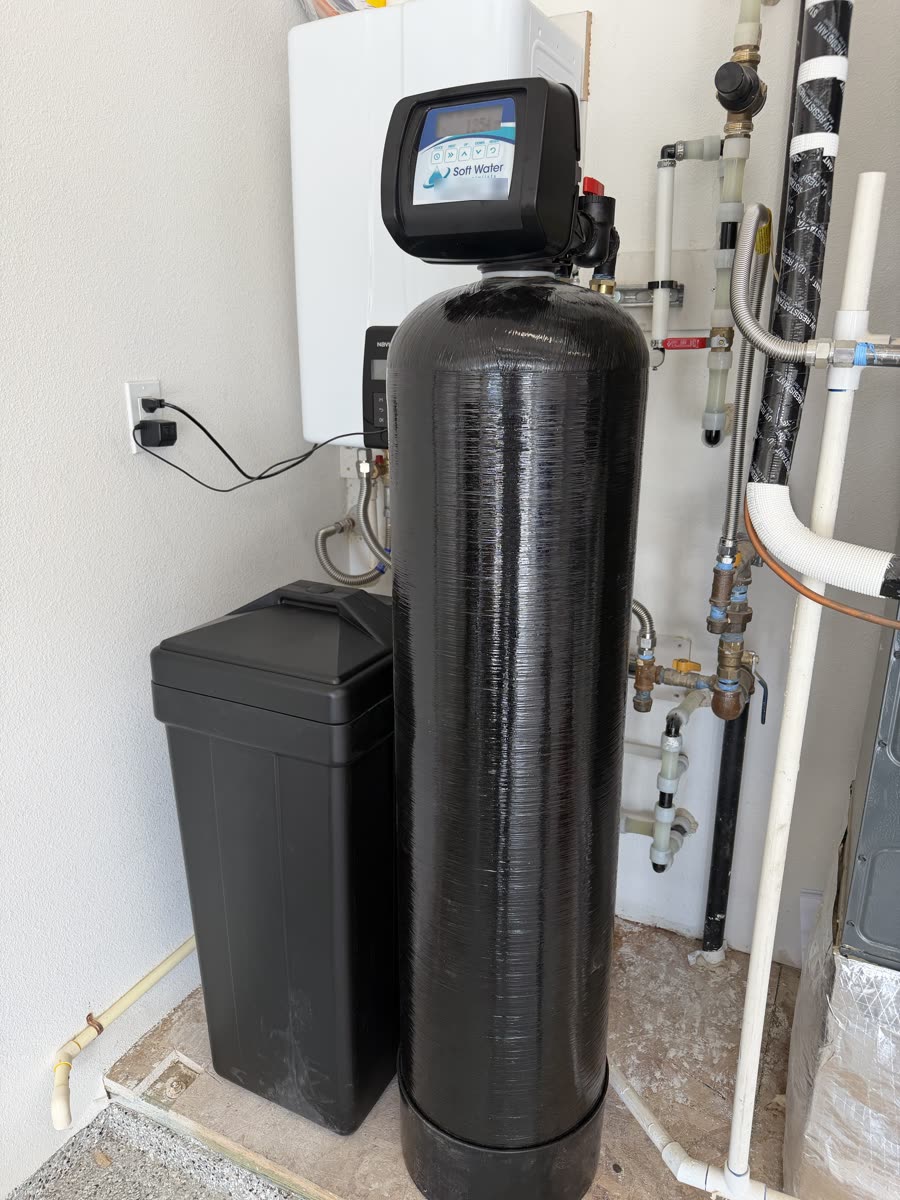
How a water softener works
The main tank holds a bed of tiny resin beads, each loosely holding sodium (or potassium, if you choose it).
As hard water flows through, the beads grab calcium and magnesium, which they hold more tightly, and let go of a little sodium in trade. The water leaving the tank is soft.
When the beads fill up with hardness, the softener regenerates, usually in the middle of the night. It rinses salty water called brine from the brine tank through the resin and flushes the captured minerals down the drain. The beads are recharged and ready again.
The three main parts
Control valve
Sits on the resin tank and runs the show. It meters water use, decides when to regenerate and steps through each cycle. It plugs into a standard outlet.
Resin tank
The tall tank holding the resin bed. All the water headed into the house passes through it, and its size sets how much hardness it holds between regenerations.
Brine tank
The shorter tank you fill with salt or potassium. It's the only part you need to check, about once a month.
Metered regeneration saves salt and water
Older softeners regenerated on a timer, used up or not. That wastes salt and water while you're away and can run short when the house is full.
We install metered, demand-based valves. They count the gallons you actually use and regenerate only when the resin is nearly full.
How we size a softener for your home
Two numbers set the size, your hardness and your household's water use. Multiply them to get the grains of hardness the softener removes each day. Here's a worked example.
| Step | Example household |
|---|---|
| Hardness from the water test | 15 gpg |
| People in the home | 4 |
| Water use per person per day | About 70 gallons |
| Daily water use | 4 × 70 = 280 gallons |
| Hardness removed per day | 280 × 15 = 4,200 grains |
| Capacity for about a week between regenerations | Roughly 30,000 grains |
Iron adds to the load, so we adjust for it. An undersized softener regenerates too often and works harder than it should.
Many newer homes already have a softener loop
Many newer homes in the valley were built with a softener loop already plumbed in, usually in the garage, with a drain and outlet close by.
A loop keeps the install clean. Outdoor hose bibs typically stay on untreated water, so you aren't softening the lawn.
No loop? Our licensed journeyman plumbers can add one, and every install includes a whole-home plumbing check.
Salt or potassium chloride
Most people use salt (sodium chloride) pellets. It's the lowest-cost choice and works well.
Softened water picks up a small amount of sodium. If you're on a low-sodium diet, use potassium chloride instead, or drink reverse osmosis water from a drinking water system. Potassium usually costs more per bag.
Most homes add salt every 4 to 6 months, and we can top it off if you text us. See salt refills.
What to expect after install
The first few weeks
- Water feels slicker in the shower. That's soap rinsing off with no hardness to grab onto.
- You'll need less soap and detergent.
- Old scale doesn't vanish overnight, but it wipes off much more easily.
Month to month
- Check the brine tank about once a month and top it up before it runs low.
- Fewer spots on dishes, glassware and shower doors, and less new scale in the water heater.
- If spots come back, the salt may have run out or crusted into a salt bridge. Call us and we'll walk you through it.
- Annual service keeps the valve and resin in good shape and keeps your limited lifetime warranty active.
Water softener questions
Can I drink softened water?
Most people do, every day. It carries a small amount of added sodium, so if you're watching sodium, use potassium or add a reverse osmosis faucet.
Does a softener need power and a drain?
Yes. The valve plugs into a standard outlet and regeneration rinses to a drain. Softener loops usually have both nearby. If that's a problem, look at salt-free scale control.
What does a water softener cost?
It depends on hardness, household size and plumbing. We price in person after testing, and you get a written quote at your free water test. See how pricing works.
Do you service softeners you didn't install?
Yes. We service any brand of water softener, not only the ones we install. See annual service.
Size your softener from real numbers
Book a free water test. We'll measure your hardness, check your setup and give you a written quote, with no pressure.