Drinking water
Reverse osmosis drinking water for Boise area homes
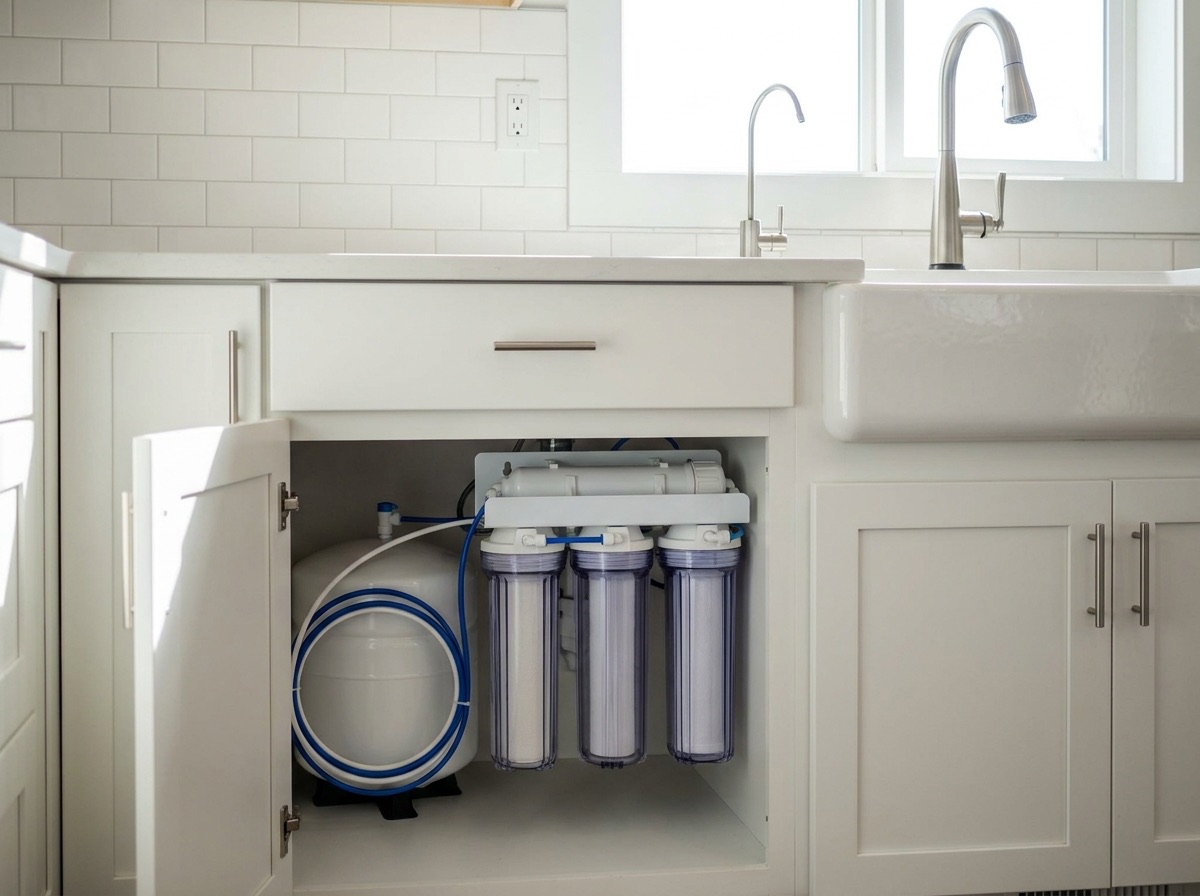
A reverse osmosis system fits under your kitchen sink and gives you clean-tasting water for drinking, cooking, coffee and ice. It reduces a wide range of dissolved contaminants that ordinary pitcher and fridge filters let through.
- Where
- Under the kitchen sink, own faucet
- Reduces
- Arsenic, nitrates, lead, TDS
- Upkeep
- Filter changes every 6 to 12 months
- Installed by
- Licensed journeyman plumbers
How reverse osmosis cleans your water
The heart of the system is a thin membrane with pores so small that water molecules pass through while most dissolved salts, metals and other contaminants are held back.
Your home's water pressure pushes water across the membrane. The clean water collects in a small storage tank, and the rejected minerals rinse away to the drain.
Filters before and after the membrane do the prep work and the final touch.
The four stages
Every glass from your RO faucet takes the same path.
Sediment filter
Catches sand, rust and grit so they don't clog the stages that follow.
Carbon filter
Takes out chlorine, which would damage the membrane, and improves taste and smell.
RO membrane
Reduces dissolved solids, including arsenic, nitrates, lead, fluoride and many PFAS.
Polishing filter
A final carbon stage after the storage tank that freshens the taste on its way to your glass.
What reverse osmosis reduces
RO is one of the most thorough ways to treat water at a single tap. These are the contaminants it reduces that we're asked about most.
This matters most for well owners. Idaho DEQ has found nitrate levels rising in groundwater in parts of Ada and Canyon counties, and some Canyon County wells have tested above standards for arsenic.
Arsenic comes in two chemical forms, and one passes through a membrane more easily than the other. On a well with arsenic, we plan around the form you have and retest after install to confirm the result.
RO does not disinfect. A well with bacteria needs UV disinfection or other treatment upstream.
- Arsenic (EPA limit 10 ppb)
- Nitrate (EPA limit 10 mg/L as nitrogen)
- Lead
- Fluoride
- Many PFAS
- Total dissolved solids (TDS), the salts and minerals that shape taste
Storage tank, faucet and ice maker
RO makes water slowly, so a small pressurized tank under the sink keeps a few gallons ready to pour. It refills on its own as you use it.
RO water comes from its own faucet, mounted next to your main kitchen faucet.
We can also run a line to your refrigerator's water dispenser and ice maker, so the ice and cold water match what comes out of the faucet.
The system sends some water to the drain as it works. That's normal. It's how the membrane rinses away what it holds back.
Filter change schedule
Typical intervals for a home system. Your water and how much you use can move these numbers.
| Part | Typical change | Why it matters |
|---|---|---|
| Sediment pre-filter | Every 6 to 12 months | Keeps grit away from the stages after it |
| Carbon pre-filter | Every 6 to 12 months | Protects the membrane from chlorine |
| RO membrane | Every 2 to 5 years | Wears with use and hardness |
| Polishing filter | About every 12 months | Keeps the taste fresh |
We can handle filter changes during annual service.
Pairing RO with a water softener
Hard water is tough on an RO membrane. Calcium and magnesium can scale its surface over time, so it wears out sooner.
Feeding RO with softened water helps the membrane last longer. RO also reduces the small amount of sodium a softener adds, right at the tap you drink from.
For many hard-water homes, a water softener for the whole house plus RO at the kitchen sink is the pairing that makes the most sense.
Drinking water questions
Does RO water taste different?
Most people describe it as clean and crisp. Because RO reduces minerals, it can taste a little flatter than tap water at first. The polishing filter helps.
Can RO treat my whole house?
Whole-house RO exists, but a home rarely needs it. For drinking and cooking, one RO faucet is the practical choice. For the rest of the house, look at a water softener or whole-home filtration.
Is RO enough for my well?
It's a strong fit for arsenic and nitrates at the kitchen tap. Bacteria, iron and sulfur need treatment upstream first. See well water treatment.
What does an RO system cost?
It depends on your water and your kitchen, including any refrigerator hookup. We price in person after testing, and you get a written quote at your free water test. See how pricing works.
Know what's in your drinking water
Book a free water test. We'll explain your results in plain language and tell you whether RO makes sense, with a written quote and no pressure.